When Things Get Bubbly, Don't Get Illiquid

Two of my recent posts involved successful investments our funds have made, so it seemed only fair to write about a failure — and not because my compliance officer said I have to. This isn’t just about one bad investment but a cluster, all within a one-year period, that wound up costing us tens of millions of dollars.
It was summer 2007 and emerging market stocks were in a full-blown bubble. The MSCI EM Index had quadrupled over the preceding 3-1/2 years, and it seemed as if any would-be EM fund manager could hang out a shingle and raise a pot of money. Our Eastern Europe funds had posted three years of average 40% net gains and were in the middle of another up year, with no sign enthusiasm was waning. We were so hot that I could’ve launched a vehicle dedicated to Fredonia, the made-up country in the Marx Brothers’ Duck Soup, and raised $50 million.
I didn’t, but the inflows into our real offerings were so large that they dwarfed anything we’d seen before (or since). By August, our assets under management had reached $3.4 billion, up $1 billion over the trailing 12 months. More than half of that was in our Eastern Europe funds, where only Russia’s stock market was liquid enough to comfortably accommodate it all.
It’s the rare manager who recognizes that he is the beneficiary of a bubble. Most will interpret their great performance and inflows the way I did, as only just and proper. Still, I had doubts, in part because of cracks that were now evident in the U.S. real estate market. A mortgage-backed securities manager friend of mine called one evening to warn me that within the year big banks could fail.
The next night, at dinner with friends also in finance, two martinis in and my eyes glazing over, I said, “We’re all dead.” That flash of clarity — maybe Baron de Rothschild speaking through me from the spirit world — had passed by morning and I continued on as if everything was fine.
Two Big Mistakes
My partner and I were conscious that our markets were getting pricey. The Moscow Stock Exchange had risen to an all-time high P/E ratio of 12, with Eastern Europe overall around 15x. We took comfort that Russia still traded cheaper than Brazil at 15x, India at 20x, and China over 30x. We realized much later that these were all peak multiples and that Russia, dominated by resource stocks, would always trade at a discount to growth-oriented Asian markets.
Even though we believed that Russian stocks were not terribly overvalued, it felt wrong to stick all our inflows into the same blue chips that had already gone up five or ten times. Meanwhile, the other markets we were in, like Romania and Estonia, were too small and thinly traded to absorb the size of cash we had to deploy. Given this dilemma, our Big Mistake #1 was to (a) keep accepting all those inflows and (b) feel pressure to invest them quickly, so as not to fall behind a trending bull market.
This pressure was increased by what we saw other managers doing. One Swiss bank had an Eastern Europe mutual fund that was buying every listed stock in Bulgaria at any price until they pushed up such beauties as a barely profitable particle-board maker and the DeWalt tools of Bulgaria up as much as 20x. This so-called “buy and buy strategy” drove the Swiss fund to great performance, leading to more inflows, leading to more buying — all in a vehicle with daily liquidity. That was insane, and of course it ended in tears.
My team and I decided that the way to adhere to our value philosophy while also deploying lots of cash quickly was via private placements and pre-IPOs, which were offered to us at discounts to publicly traded comps. To reduce risk, we diversified, so no one holding would be highly material to the overall fund; we spent $10 million here, $5 million there, out of a net asset value approaching $1 billion.
A number of these came from Ukraine, where entrepreneurs with ethics ranging from potentially honest to outright thieving mobilized to feed the ducks that were quacking. Our doomed Ukrainian investments included real estate developers, an agribusiness, and a vodka company. With the vodka, we relied on the due diligence by a well-known New York-based fund; known, unfortunately, for U.S. investing and not for difficult emerging markets. This fund and its British law firm, with their fancy contracts governed under U.K. law, proved no match for an asset-stripping Ukrainian.
Getting more illiquid was Big Mistake #2. These not yet cash-generative private companies hit a wall as the 2008 crisis unfolded, and the pre-IPOs had no market to IPO in. Meanwhile, our inflows suddenly became large outflows, forcing us to use up our cash reserve and then sell quality liquid stocks, thus making the troubled private holdings bigger weightings. By the end of 2008 we had to suspend fund redemptions to protect all investors, including those who wanted to stay and ride out the correction.
Long Term Consequences
Besides the vehicle that had big inflows in 2006-07 and made most of these illiquid investments — call it Fund A — we had two other Eastern Europe funds that were already closed to new investors during the bubble and so didn’t have hot money to deploy. These others broke through their high-water marks for performance fees (i.e., peak year-end NAV) many years sooner than Fund A, which struggled with trying to exit or writing off the illiquid positions. The permanent losses of capital on those — none individually very big, but numerous — were a heavy anchor.
On the subject of high-water marks (HWMs), we believe in honoring them however long it takes to recoup investors’ money, a view that is unfortunately not universal among hedge funds. I’m aware of managers, even ones calling themselves governance activists, who escaped HWMs after a big loss, including by threatening to liquidate unless the marks were reset lower.
Another time-honored way around a HWM is to close down the fund to “spend time with [my] family” and a year later, presumably after enough of the family, resurface with a new fund lacking a HWM. Private equity managers don’t have to worry about this, because if Fund I doesn’t look like it will generate a performance fee, they can launch II, III, IV, all the way to L until they hit the right vintage.
Lessons and a Dog’s Dream
Emerging markets in 2007 were unquestionably a bubble, in which the right move for an investor was to get more liquid, not less. What about everyone’s favorite topic, AI?
Investors just arriving to the AI party will be tempted not to buy stocks like Nvidia that are already up many times, but instead to look for a listed junior or private company that might be “the next Nvidia.” Thinking Machines, a startup by some ex-Open AI executives, has just raised $2 billion at a $12 billion valuation, most of which I’d guess came from funds using other people’s money. Those “other people” will, believe it or not, expect to be paid back at some not-distant point in the future.
If AI is in the early stages of a long bull market, then these privates and juniors could work out great. But if AI is already a bubble, then investors should be avoiding illiquidity and sticking with blue chips that can be sold if the wave crests. I don’t know which is true, but what I am pretty sure of is that if a real AI bubble does form, 95% of the fund managers participating in the boom will do the wrong things. This will leave it to the “other people” to act and protect themselves.
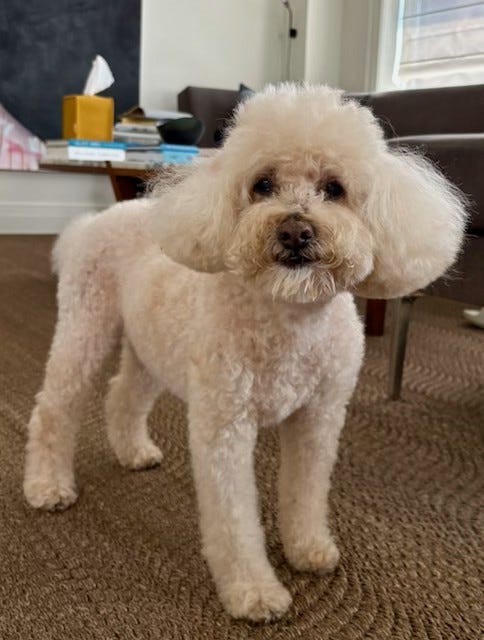
As for emerging markets, it happens that when the index peaked in 2007, I was heading to LaGuardia Airport to pick up a cockapoo puppy that had been air-shipped from an Ohio breeder. Teddy has, through sheer force of will (and great love of food), lived to see his dream realized as the EM index has at last taken out its old high, 18 years later.